Is Kratom Legal? 2026 Kratom Legality Map & Laws by State

Last updated: August 26, 2026 · Reviewed weekly by the Kingdom Kratom team
Quick answer: Yes — kratom is legal at the federal level and in the large majority of U.S. states. As of August 2026 it is banned in ten states plus Washington, D.C., and “leaf-legal, 7-OH-restricted” in a growing group of others. Use the color-coded map below to check any state, then open its full guide.
Kratom's legal status changes faster than almost any other botanical, and it varies dramatically from one state to the next. This page is our living map of where kratom stands right now. Hover over a state (or tap it on mobile) to see its current status, then click through for the full breakdown — bills, effective dates, age limits, and how 7-OH is treated.
Hover over a state for its status (on mobile, tap once to preview and again to open its guide). Colors reflect status as of August 2026. If the map doesn't load, use the full state list below.
State color reflects state law; some cities have local restrictions that are applied automatically at checkout.
Kratom legality by state (2026)
Prefer a list? Here's every state and D.C., grouped by status, with a direct link to its full guide.
Banned (illegal)
Alabama, Arkansas, Connecticut, Washington D.C., Indiana, Kansas, Louisiana, North Dakota, Tennessee, Vermont, and Wisconsin.
Leaf legal, concentrated 7-OH restricted
Colorado, Florida, Mississippi, Ohio, South Carolina, and Virginia.
Legal & regulated (Kratom Consumer Protection Act)
Arizona, Georgia, Nebraska, Nevada, New York, Oklahoma, Oregon, Rhode Island, Texas, Utah, and West Virginia.
Legal (no dedicated statewide regulation)
Alaska, California*, Delaware, Hawaii, Idaho, Illinois, Iowa, Kentucky, Maine, Maryland, Massachusetts, Michigan, Minnesota, Missouri, Montana, New Hampshire, New Jersey, New Mexico, North Carolina, Pennsylvania, South Dakota, Washington, and Wyoming.
*California has no statewide ban statute, but the state health department has moved to restrict retail kratom sales — see the California guide for the current picture.
Age limits at a glance: a growing list of states sets a 21+ minimum — including Texas, Florida, Georgia, Colorado, Mississippi, New York, Oregon, South Dakota, and Virginia — while several others (Arizona, Illinois, New Hampshire, North Carolina) use 18+. Each state's guide has the specifics.
The biggest kratom law changes in 2025–2026
- Louisiana — full ban, effective August 2025.
- Connecticut — full ban by regulation (March 2026).
- Rhode Island — first state ever to reverse a ban; regulated market opened April 2026.
- Kansas & Tennessee — bans effective July 1, 2026.
- North Dakota — banned by executive order effective August 5, 2026, with the Board of Pharmacy scheduling 7-OH; a special legislative session on permanent legislation convenes September 2.
- Florida, Ohio, Virginia, Colorado, South Carolina — restricted concentrated 7-OH while keeping natural leaf legal.
- New York — first statewide regulation (21+ and warning labels).
Is kratom legal federally? The DEA's 2026 7-OH crackdown
Yes — kratom is legal at the federal level. It is not a controlled substance, and it's legal to manufacture, sell, and possess nationwide, subject to FDA labeling authority. On July 1, 2026, the DEA filed its intent to temporarily place concentrated and synthetic 7-OH into Schedule I, along with three related lab-made compounds (mitragynine pseudoindoxyl, MGM-15, and MGM-16), a move HHS supported. Crucially, the DEA stated the action does not apply to natural kratom leaf containing 7-OH below a low threshold (about 0.05% by dry weight) — it targets synthesized and concentrated products, not the plant. We cover it in detail in what the DEA's 7-OH scheduling really means.
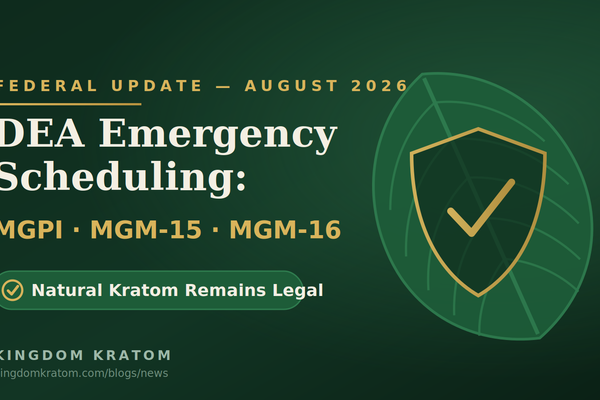
Update — August 26, 2026: that action is now in force. On August 25, the Department of Justice announced emergency Schedule I scheduling of MGPI, MGM-15, and MGM-16, again stating explicitly that the action is “directed at deliberately manufactured and concentrated opioid products, not traditional botanical kratom.” Full breakdown: DEA emergency-schedules MGPI, MGM-15 & MGM-16.
Frequently asked questions
Is kratom legal in the United States?
Yes, at the federal level and in most states. As of August 2026 it is banned in ten states plus Washington D.C., and restricted (leaf legal, concentrated 7-OH limited) in several others.
What states is kratom illegal in?
Alabama, Arkansas, Connecticut, Indiana, Kansas, Louisiana, North Dakota, Tennessee, Vermont, Wisconsin, and Washington D.C. Always check your state's current status — this list changes.
Is 7-OH legal?
Natural kratom leaf (with only trace 7-OH) is broadly legal, but concentrated and synthetic 7-OH products are restricted in a growing number of states and were placed under emergency federal Schedule I control in 2026, along with the related compounds MGPI, MGM-15, and MGM-16.
How often is this map updated?
We review it weekly, but kratom laws can change between updates. Treat it as a starting point and confirm your state's current status before you buy.
Disclaimer: This map and guide are for general informational purposes only, are not legal advice, and we do not guarantee they are fully up to date. Kratom laws change frequently and can vary by locality. Before relying on this information, verify your state's current status with primary sources and the American Kratom Association. Kingdom Kratom makes no health or therapeutic claims about kratom.