Is Kratom Legal in Texas? Laws, 7-OH Rules & Where to Buy

Last updated: July 2026 · Written by the Kingdom Kratom team in San Antonio, TX
Quick answer: Yes — kratom is legal in Texas. Natural kratom leaf is not a controlled substance here, and adults can buy, possess, and use it statewide. Since 2023, sales have been governed by the Texas Kratom Consumer Protection Act (KCPA), which sets labeling and purity standards and puts a legal cap on how much 7-hydroxymitragynine (7-OH) a product can contain. As of July 2026 there is no statewide ban, though a handful of cities have their own rules.
If you've searched "is kratom legal in Texas" and come away more confused than when you started, you're not alone. Some pages say it's perfectly legal, others mention lawsuits and warnings, and the truth sits in the middle: kratom is legal and regulated in Texas. Those are two different things, and understanding the difference is the whole ballgame.
As a Texas-based company that's been selling lab-tested kratom since 2017, we follow this law closely. Here's the plain-English version.
Is kratom legal in Texas right now?
Yes. Texas has never scheduled kratom as a controlled substance, and there is no statewide prohibition on buying, owning, or using it. What Texas does have is a consumer-protection framework — the Texas Kratom Consumer Protection Act, signed into law in 2023 and codified in the Texas Health and Safety Code. In other words, kratom isn't in a legal gray zone in Texas; it's legal on purpose, with guardrails.
That status held firm through the last legislative cycle. A bill to ban kratom, SB 1868, was filed in the 2025 session but died when the session ended in June 2025 without ever getting a House hearing. Kratom's legal footing in Texas is currently stable.
What the Texas Kratom Consumer Protection Act actually requires
The KCPA is the reason "legal" and "unregulated" aren't the same thing in Texas. Under the Act, companies that make or sell kratom in the state have to play by real rules:
- Accurate labeling — products must disclose what's in them, so you know the strain and alkaloid content you're actually buying.
- Purity standards — kratom can't be adulterated or contaminated with other substances.
- A cap on 7-OH — the law limits how much 7-hydroxymitragynine a product may contain. This is the single most important detail, and it's where most enforcement action has landed (more on that below).
- Age restrictions — the Act restricts sales to minors.
For a reputable, compliant seller, none of this is a burden — it's just how we already operate. The KCPA mainly exists to push bad actors out of the market.
Natural leaf vs. concentrated 7-OH: the distinction that matters
Here's the nuance the news headlines usually blur. Natural kratom leaf contains mitragynine as its dominant alkaloid, with only trace amounts of 7-OH. Some manufacturers, though, sell concentrated or semi-synthetic 7-OH products — tablets, shots, and gummies engineered to be far more potent than anything in the plant. Those are the products regulators nationwide are targeting.
Texas made this concrete in 2025 when Attorney General Ken Paxton sued several kratom retailers for selling products that blew past the statutory 7-OH limit and for deceptive marketing. That was an enforcement action against non-compliant sellers — not a change to the law and not a ban on kratom. Traditional leaf products that meet the KCPA's limits remained perfectly legal throughout. We break the leaf-vs-7-OH issue down further in our guide to what the DEA's 7-OH action really means.
Are there local kratom bans in Texas?
Statewide, you're clear. But Texas is big, and a few municipalities have explored or enacted their own restrictions on where and how kratom can be sold. These local ordinances are the exception, not the rule, and they don't override the fact that kratom is legal at the state level. If you live in or near a major metro, it's worth a quick check of your city's rules before assuming every shop stocks it.
The DEA's July 2026 decision on 7-OH — and why kratom leaf isn't banned
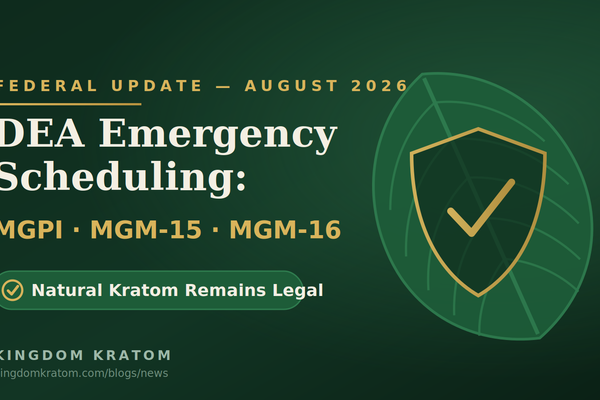
This is the federal news everyone's asking about, so let's be precise. On July 1, 2026, the DEA filed its intent to temporarily place concentrated and synthetic 7-OH into Schedule I, along with three related lab-made compounds — mitragynine pseudoindoxyl, MGM-15, and MGM-16. HHS reviewed the science and backed the move. Once the temporary orders take effect, manufacturing, selling, or possessing those covered 7-OH substances becomes a federal offense.
Here's the part the headlines bury: the DEA stated plainly that the action does not apply to natural kratom leaf with naturally occurring 7-OH below a low threshold (about 0.05% by dry weight). In the agency's own words, it "targets synthesized products and those containing elevated concentrations of 7-OH" — the gas-station tablets, gummies, and shots — not traditional mitragynine-dominant kratom. In other words, the federal government just drew the same line we always have: natural leaf on one side, engineered 7-OH concentrates on the other. Kratom itself remains federally legal. We unpack it fully in what the DEA's 7-OH scheduling really means.
How Texas compares to nearby states
Texas is one of the friendlier states for kratom, sitting alongside others that have passed a Kratom Consumer Protection Act. Its neighbors are a mixed bag: Oklahoma also regulates kratom under a KCPA, while Arkansas and Louisiana have banned it outright. That patchwork is exactly why travel matters — a product that's legal at home in Texas can carry real legal risk a few hours down the interstate. You can see the full picture in our state-by-state kratom legality guides.
Where to buy lab-tested kratom in Texas
Because Texas regulates kratom rather than banning it, you have plenty of options — but the KCPA is only as good as the seller standing behind it. Look for a vendor that publishes third-party lab results, labels alkaloid content honestly, and stays within the state's 7-OH limit.
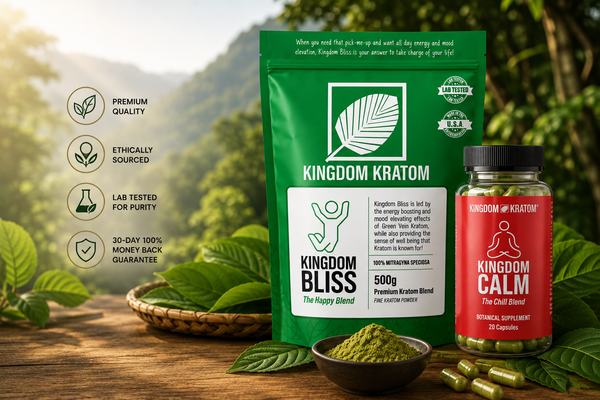
That's the standard we've held since day one. You can explore our full range of lab-tested kratom, from kratom powder and capsules to extracts, all shipped to Texas addresses. New to it? Our sample packs are an easy place to start.
Frequently asked questions
Is kratom legal in Texas in 2026?
Yes. Kratom is legal statewide in Texas and regulated under the Texas Kratom Consumer Protection Act. It is not a controlled substance, and there is no statewide ban as of July 2026.
Is kratom regulated in Texas?
Yes. Unlike many states, Texas has an active consumer-protection law requiring accurate labeling, purity standards, a cap on 7-OH content, and age restrictions on sales.
Did Texas ban kratom?
No. A ban bill (SB 1868) was introduced in 2025 but failed to pass. Separately, the Texas Attorney General sued some retailers for selling illegal high-7-OH products — an enforcement action against specific sellers, not a ban on kratom.
How old do you have to be to buy kratom in Texas?
The Texas KCPA restricts kratom sales to minors. Reputable retailers verify age at checkout; check a specific seller's policy for their exact age requirement.
Can kratom be shipped to Texas?
Yes. Since kratom is legal statewide, compliant vendors can ship it to Texas addresses. Local city rules may still apply in a small number of areas.
This article is general information about Texas law as of July 2026 and is not legal advice. Kratom laws change quickly — verify current local rules before you buy. Kingdom Kratom makes no health or therapeutic claims about kratom.