Is Kratom Legal in Georgia? Age Limits, KCPA Rules & 7-OH Update

Last updated: July 2026 · Written by the Kingdom Kratom team
Quick answer: Yes — kratom is legal in Georgia for adults 21 and older. It's regulated under Georgia's Kratom Consumer Protection Act (KCPA), and as of January 1, 2025 the minimum purchase age is 21. A 2026 bill to ban kratom failed, so the plant's legal status is secure. Natural leaf kratom remains legal; only concentrated 7-OH products face new restrictions.
Georgia was one of the earliest states to protect kratom with real consumer rules, and it remains a firmly legal state today. If you're wondering whether you can buy kratom in Atlanta, Savannah, or anywhere in between, the short answer is yes — you just need to be 21. Here's the full picture.
Is kratom legal in Georgia right now?
Yes. Kratom is legal statewide in Georgia and has been regulated since the state passed its Kratom Consumer Protection Act in 2019. It is not a controlled substance. The most important recent change isn't a ban — it's an age update: as of January 1, 2025, House Bill 181 raised the minimum purchase age to 21 (it was previously 18).
Georgia's legal status was tested again in the 2026 session, when a bill to schedule kratom as a controlled substance (HB 968) was introduced. It did not pass either chamber. Kratom remains legal and regulated in the Peach State.
What Georgia's Kratom Consumer Protection Act requires
The KCPA is why Georgia is a "legal and regulated" state rather than a legal free-for-all. Under the law and its 2025 update, sellers must follow standards designed to protect buyers:
- 21+ purchase age — retailers may not sell kratom to anyone under 21.
- Honest labeling — products must disclose ingredients and alkaloid content.
- No adulterated products — kratom can't be contaminated or spiked with dangerous additives.
- Accountability for sellers — vendors that break these rules face penalties.
For a quality-focused company, these are simply table stakes. The KCPA's real job is to keep unsafe, mislabeled products out of Georgia stores.
Natural leaf vs. 7-OH: know the difference
When you read about kratom "crackdowns," they're almost always about 7-OH — not the leaf. 7-hydroxymitragynine (7-OH) occurs in kratom leaf only in trace amounts, but some manufacturers sell concentrated or semi-synthetic 7-OH tablets, gummies, and shots that are far stronger than anything found in nature. Those concentrates are what regulators are targeting nationwide. Traditional mitragynine-dominant leaf kratom — the kind sold as powder and capsules — is a different product with a different legal footing.
The DEA's July 2026 decision on 7-OH — and why kratom leaf isn't banned
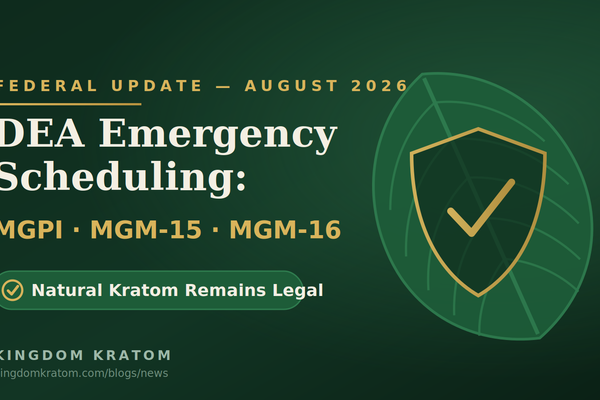
Here's the national headline worth understanding. On July 1, 2026, the DEA filed its intent to temporarily place concentrated and synthetic 7-OH into Schedule I, along with three related lab-made compounds (mitragynine pseudoindoxyl, MGM-15, and MGM-16). HHS backed the move, and once the temporary orders take effect, those covered 7-OH products become federally controlled.
But the DEA was clear that the action does not apply to natural kratom leaf with 7-OH below a low threshold (about 0.05% by dry weight); it "targets synthesized products and those containing elevated concentrations of 7-OH." So even at the federal level, natural leaf kratom stays legal — it's the concentrates that are being scheduled. That distinction is the whole story, and we cover it in depth in what the DEA's 7-OH scheduling really means.
Are there local kratom bans in Georgia?
Georgia's KCPA sets a consistent statewide standard, and there are no major local prohibitions that override it — kratom is broadly available across the state to adults 21+. As always, if a specific city has adopted its own retail rules, it's smart to confirm locally, but Georgians generally follow one statewide framework.
How Georgia compares to its neighbors
Georgia is one of the more kratom-friendly states in the Southeast, sitting comfortably in the "legal and regulated" column. Its region is uneven, though: Florida keeps leaf legal but bans concentrated 7-OH, while Alabama has banned kratom entirely. If you travel across state lines, don't assume Georgia's rules apply elsewhere. Our state-by-state legality guides lay out each one.
Where to buy lab-tested kratom in Georgia
Because kratom is legal and regulated for adults 21+, Georgians have plenty of choices — but the KCPA only works if your seller actually follows it. Choose a vendor that verifies age, publishes third-party lab results, and sells honestly labeled leaf kratom.
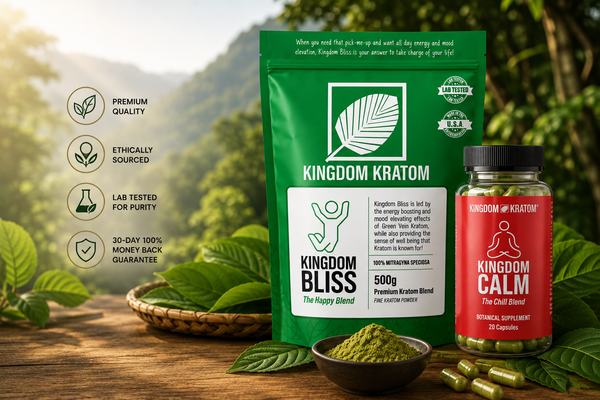
That's how we've operated since 2017. Explore our lab-tested kratom shop — including powders, capsules, and sample packs — all shipped to Georgia customers who are 21 and older.
Frequently asked questions
Is kratom legal in Georgia in 2026?
Yes. Kratom is legal statewide for adults 21 and older, regulated under Georgia's Kratom Consumer Protection Act. It is not a controlled substance.
How old do you have to be to buy kratom in Georgia?
You must be 21 or older. Georgia raised the minimum age from 18 to 21 effective January 1, 2025, under House Bill 181.
Did Georgia try to ban kratom?
Yes, in 2026 a bill (HB 968) sought to schedule kratom as a controlled substance, but it did not pass. Kratom remains legal in Georgia.
Is 7-OH legal in Georgia?
Natural leaf kratom (with only trace 7-OH) is legal. Concentrated and synthetic 7-OH products are the target of the DEA's July 2026 Schedule I action and face growing restrictions.
Can kratom be shipped to Georgia?
Yes. Compliant leaf kratom can be shipped to Georgia buyers who are 21 or older.
This article is general information about Georgia law as of July 2026 and is not legal advice. Kratom laws change quickly — verify current local rules before you buy. Kingdom Kratom makes no health or therapeutic claims about kratom.